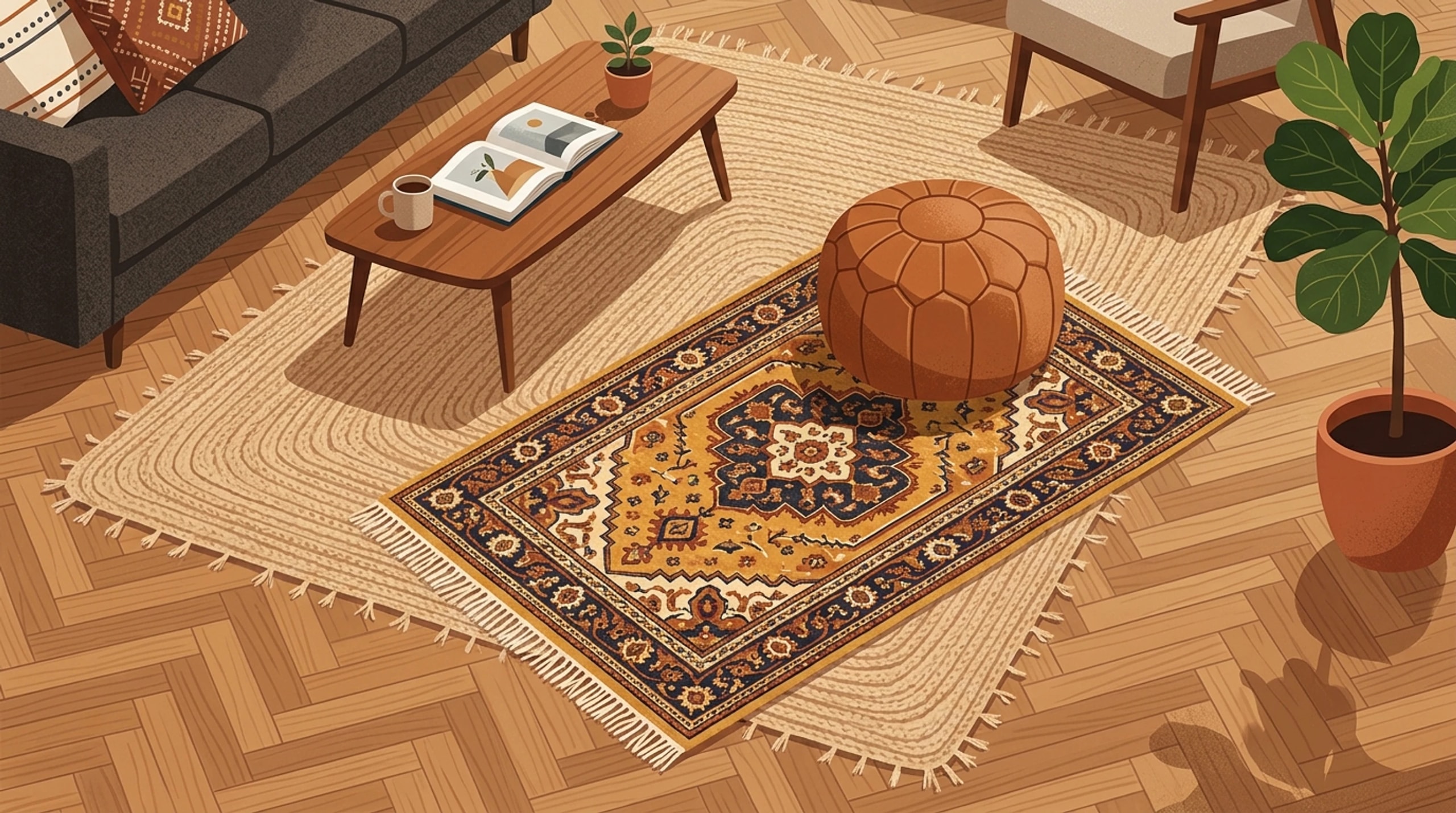
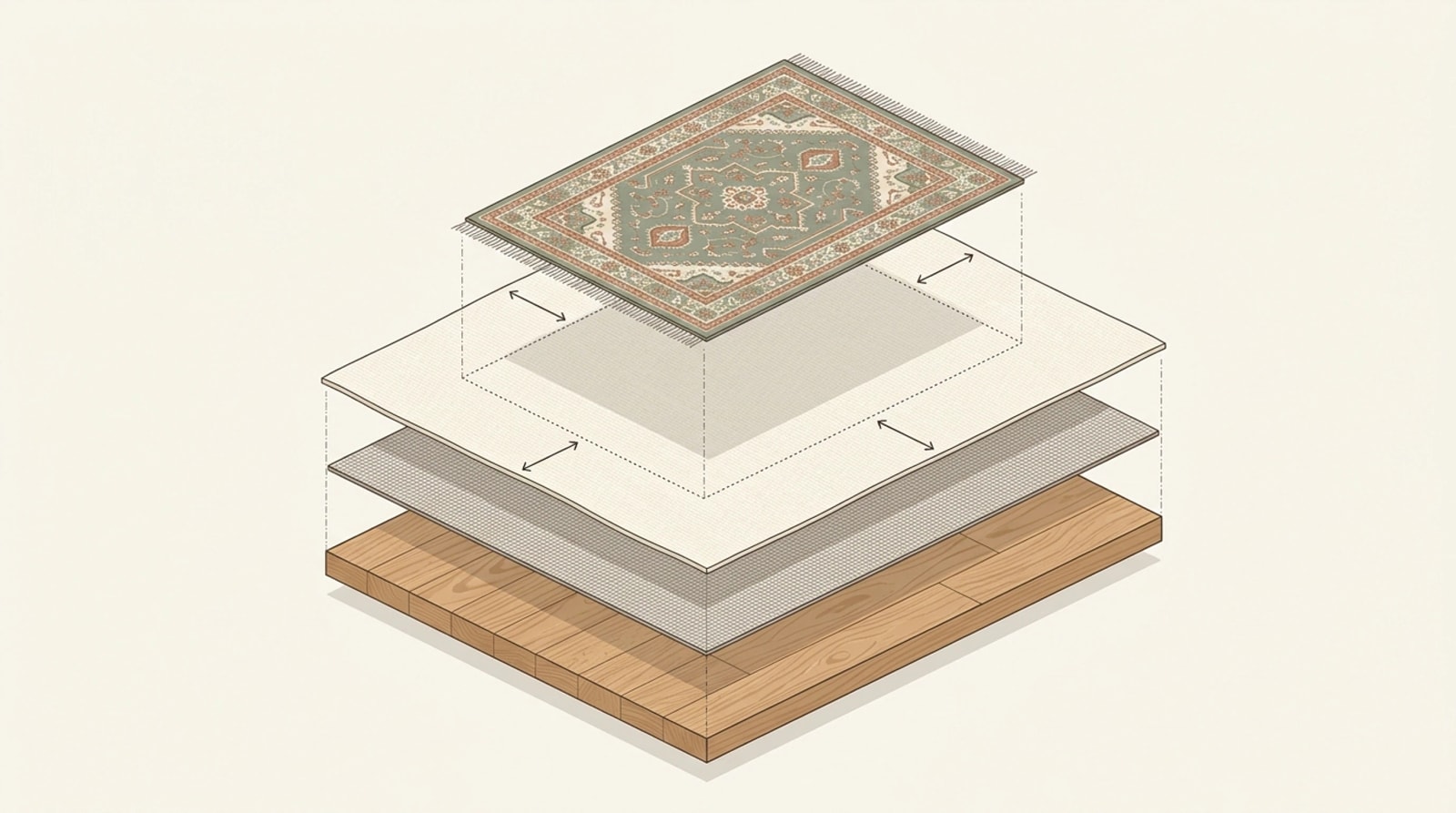
Layering rugs is a designer trick that adds depth and personality to a room. A smaller, softer or more patterned rug sits on top of a larger base rug, so you get two textures and more color in one move. It also lets you use a big, affordable rug as a base and keep a special piece on top.
Why layer rugs?
- Add texture and depth to a plain room
- Mix patterns and colors without committing to one big pattern
- Define zones in an open-plan space
- Cover a too-small rug or stretch a budget by using a large neutral base
- Add comfort by putting a soft rug over a hard flat weave
The basic recipe
Use a large, simple base rug and a smaller, more interesting rug on top. The base rug should be neutral and flat, such as jute or sisal. Our wool vs jute guide helps you choose.
Rug sizes for layering
| Room | Base rug | Top rug | | --- | --- | --- | | Living room | 8x10 or 9x12 | 5x8 or 4x6 | | Bedroom | 8x10 or 9x12 | 5x7 or 3x5 | | Dining room | 9x12 | Not recommended (chairs catch) | | Entryway | 5x8 | 3x5 |
A good rule is to leave at least 6 to 12 inches of the base rug visible on all sides of the top rug. See our rug size guide for choosing the base rug.
Layering combinations that work
- Jute base and patterned wool rug: the classic. The natural base calms a bold top.
- Neutral flat weave and a cowhide or sheepskin: adds softness.
- Sisal base and a kilim: crisp texture and bold pattern.
- Wool base and a smaller color accent rug: good for adding a seasonal color.
Placement ideas
- Living room: put the top rug slightly off-center under the coffee table, or angled for a relaxed look.
- Bedroom: place the top rug at the foot of the bed, under the lower two-thirds.
- Open plan: use different top rugs to mark the sitting and dining areas.
How to keep layered rugs safe and flat
Layering can create trip hazards if you are not careful.
- Use a rug pad under the base rug. See our rug pad guide.
- Grip the top rug with a thin non slip pad or rug tape on the underside.
- Pick a flat base. A thick shag base makes the top rug move and bunch.
- Avoid layering over busy walkways unless you secure the edges.
Mistakes to avoid
- Two competing patterns of the same scale
- A top rug that is too small, so it looks like a doormat
- Two thick rugs, which create an uneven surface
- Skipping the pad
Mixing patterns
If both rugs have patterns, choose different scales (one large, one small) and keep them in a shared color family. For more on color and pattern see how to choose rug colors and patterns, and for ways to build texture in the whole room see how to add texture to a room.
Related guides
The Kindred Weave editors. We write practical guides to handmade rugs and tapestries. Learn more about us.