Kilim rugs and Persian rugs are two of the great traditions of handmade textiles, and they are often mentioned together. Yet they are made in very different ways and bring very different looks to a home. A kilim is flat, light and graphic. A Persian-style rug is plush, detailed and traditional. Knowing the difference helps you choose the right one, and avoid paying for something that is not what the label suggests.
What is a kilim rug?
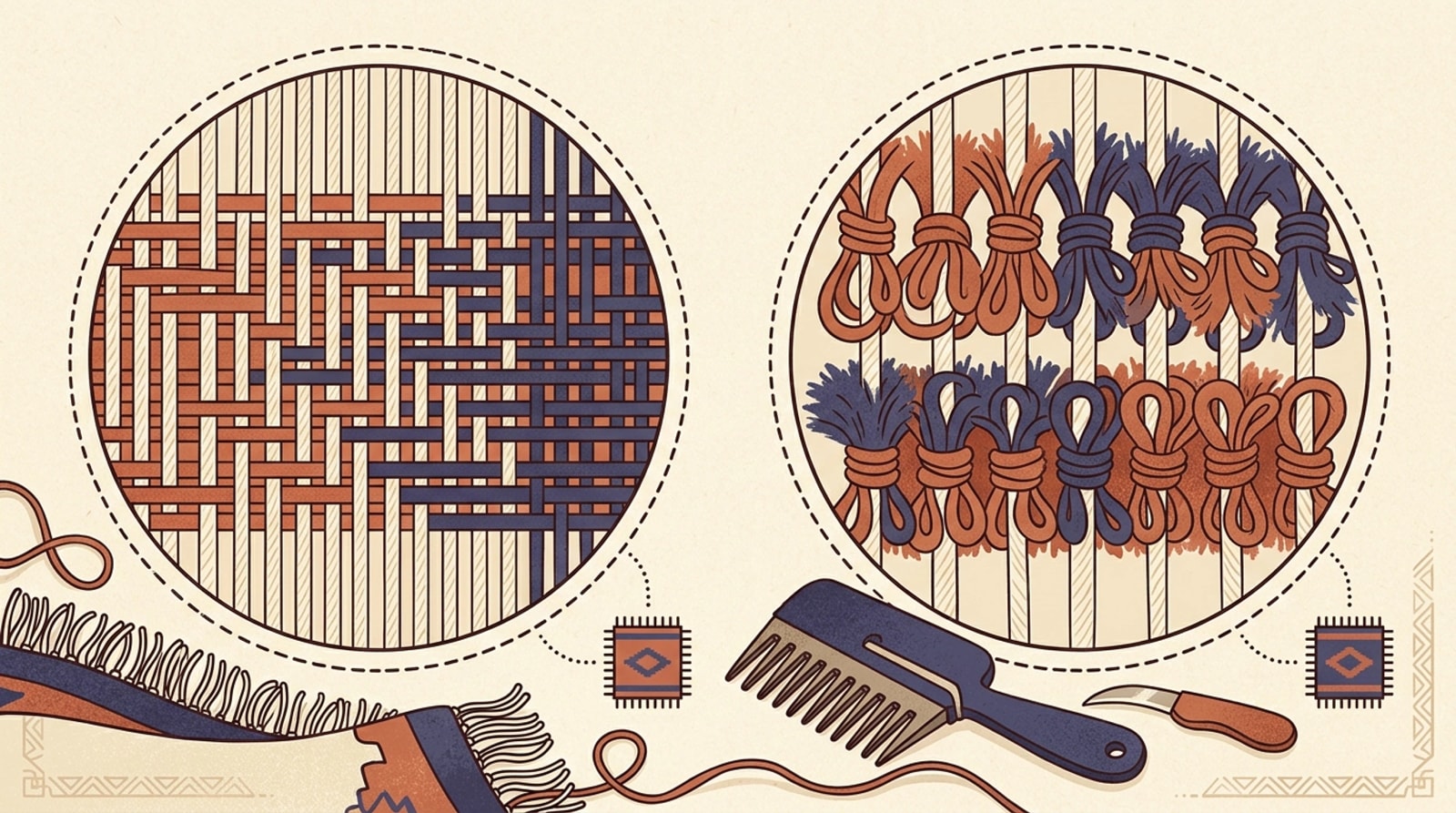
A kilim is a flat-woven rug. Instead of tying knots to make a pile, the weaver passes colored weft threads over and under the warp, building the pattern directly into the fabric. There is no pile, so the surface is smooth and the design looks the same on both sides.
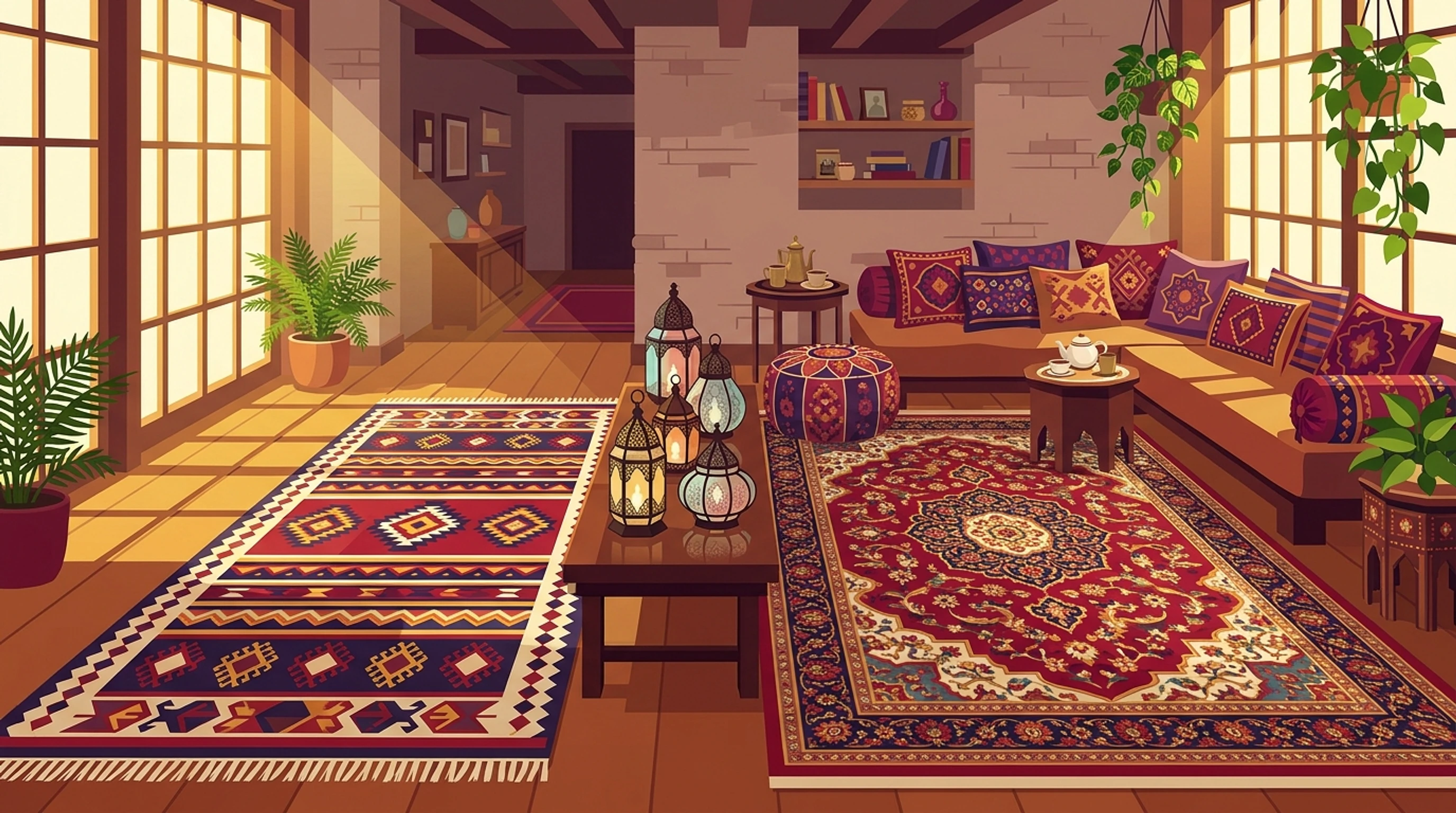
Kilims are woven across Turkey, Iran, the Caucasus, the Balkans and Central Asia, and the best known have bold geometric designs: stripes, diamonds, zigzags and stepped motifs, usually in wool or a wool and cotton mix. Related flatweaves include Indian dhurries and the denser, slightly raised soumak weave.
What is a Persian rug?
A true Persian rug is a hand-knotted pile rug made in Iran. Each knot is tied by hand around the warp threads, row after row, which creates a dense, durable surface and allows very detailed designs. Classic Persian designs include a central medallion, sweeping floral patterns and richly decorated borders. Famous weaving centers include Tabriz, Kashan, Isfahan, Heriz and Qum, and each has its own style.
What does Persian-style mean?
"Persian-style" or "traditional" describes a rug that uses these classic designs but is not necessarily made in Iran. It may be hand-knotted in India, Pakistan, Turkey or Egypt, hand-tufted, or machine-made in Belgium, Turkey or China. Persian-style rugs can be excellent and offer the look at a wide range of prices, but the label tells you about the design, not the origin or the construction. Always ask how and where the rug was made. Our guide to handmade vs machine-made rugs explains how to tell the difference.
Kilim vs Persian: the key differences
- Construction: kilims are woven flat. Persian rugs are knotted to create a pile.
- Texture: kilims are smooth and thin. Persian rugs are soft and cushioned.
- Design: kilims are bold, geometric and graphic. Persian rugs are ornate, with curves, flowers and medallions.
- Weight: kilims are light and easy to move. Persian rugs are heavier.
- Reversibility: most kilims can be used on either side. Persian rugs have one face.
- Price: kilims generally cost less than hand-knotted rugs of similar size.
- Durability: a good hand-knotted Persian rug lasts for generations. Kilims are tough but thinner and can wear at the edges.
Which should you choose?
Choose a kilim if you want a casual, graphic look, a light rug for a dining room, entryway or kitchen, a rug to layer over another rug, or a more affordable handmade piece.
Choose a Persian or Persian-style rug if you want a cushioned, formal or heirloom feel for a living room or bedroom, or a bold pattern that can carry a whole room.
Both are made from wool, so the same care rules apply. Read our wool rug guide for what to expect from the fiber.
Spotting quality
For kilims
- Even, straight edges and a design that is crisp on both sides.
- A tight, firm weave with no loose or gaping areas.
- Colors that are consistent within each band. Natural dye variation (called abrash) is normal and often prized.
- Intact ends and fringe. Fringe is made of the warp threads, so look for secure ends.
For Persian and Persian-style rugs
- Check the back. In a hand-knotted rug, the pattern is clear on the reverse and you can see the individual knots. A uniform grid or a latex backing suggests a machine-made or tufted rug.
- Knot density matters. Higher knot counts generally allow finer detail, but a finer rug is not always better for a busy room.
- Feel the wool. It should be springy and slightly lustrous, not stiff or oily.
- Ask for origin and materials in writing, and be careful with claims of "antique" or "silk" that are not backed up.
How to style them
- Let a kilim add pattern to a neutral room. A striped or geometric kilim brings energy to white walls, wood floors and simple furniture.
- Use a Persian rug as the anchor. Choose furniture in calm colors and let the rug supply the pattern and warmth.
- Mix old and new. A traditional rug under a contemporary sofa looks fresh and deliberate.
- Layer them. A kilim over a large jute rug is a classic combination.
- Pull a color from the rug into cushions or art, as described in our guide to choosing rug colors and patterns.
Sizing and placement
Use our rug size guide to choose dimensions, and remember that formal designs with borders look best when the rug is large enough to sit under the main furniture. Kilims are often sold as runners, which suit hallways and kitchens well. See our guide to entryway and hallway rugs.
Caring for them
- Use a rug pad. Thin kilims especially benefit from a felt and rubber rug pad, which stops slipping and adds cushion.
- Vacuum carefully. Use suction only and avoid the fringe. Kilims can be vacuumed on both sides.
- Rotate the rug a few times a year and keep it out of direct sun, which fades natural dyes.
- Blot spills straight away and follow our guide to cleaning a wool rug.
- Call a specialist for deep cleaning of antique pieces.
Frequently asked questions
What is the difference between a kilim and a Persian rug? A kilim is woven flat with no pile and has bold geometric designs. A Persian rug is hand-knotted with a pile and usually features ornate medallions and florals.
Is a Persian-style rug a real Persian rug? Not necessarily. Persian-style describes the design, and the rug may be made in many countries by hand or machine.
Are kilim rugs durable? Yes, a well-made kilim is tough and long lasting, though it is thinner than a pile rug and the edges can wear.
Can you use a kilim rug in a living room? Yes. It works well as a casual, graphic centerpiece and with a pad it is comfortable underfoot.
Are kilim rugs reversible? Most are, because the pattern is woven into the fabric and looks the same on both sides.
The Kindred Weave editors. We write practical guides to handmade rugs and tapestries. Learn more about us.